 IKF
IKF
MODIFIED MUAY THAI
RULES
- MMTR -
Please
see
GENERAL BOUT RULES PAGE
In ADDITION to the rules below. - Click
HERE
HOME - NEWS - EVENTS - RANKINGS - SANCTIONING - JOINING - RULES & REGULATIONS - MERCHANDISE - ISCF MMA
THE HISTORY OF IKF MUAY
THAI
ONE OF THE FIRST TO SANCTION AND REGULATE IT HERE IN THE USA
CLICK
HERE
MODIFIED MUAY THAI
RULES
Any Bout that does not
allow Knees "AND" Elbows to the Head &
Body of a Fighter is considered "MODIFIED" Muay Thai.
This can
mean bouts with Knees to the Body only, Limited Clinch, Elbows to the Body only,
etc.
WHICH MEANS
Matchmakers
shall determine with each bout and it's fighters what rules below will be
modified/allowed for their bout.
DETAIL
AMATEUR
EVENTS
AMATEUR
TOURNAMENT
EVENTS
PRO BOUTS
KICKS
ABOVE WAIST
YES
YES
YES
KICKS
TO THE LEGS
YES
YES
YES
KICK
MINIMUM
NO
NO
NO
KNEES
- All Knee Targets shall be determined during event matchmaking with each
fighter of each fight and the event matchmaker.
Please CONFIRM with the Event Matchmaker & The IKF Event Representative what will be ALLOWED in your bout.- PRO & AMATEUR MODIFIED MUAY THAI: Allows for the option of
various technique "TARGETS".
- Elbows to the Body & Legs Only.
- Knees to the Body & Legs Only.
- Knees to the Body, Head and Legs but Elbows to the Body & Legs Only.
- Limited or no Clinch.
- Rules may adapt in many different ways.
- AMATEUR TOURNAMENT
COMPETITION FOR MODIFIED MUAY THAI
Knees are allowed to the Body and Legs below the shoulder line but NOT to the Head.
- PRO & AMATEUR MODIFIED MUAY THAI: Allows for the option of
various technique "TARGETS".
SWEEPS
Foot To Foot - No Spin Sweeps
YES
YES
YES
ELBOWS
- All Elbow Targets shall be determined during event matchmaking with each
fighter of each fight and the event matchmaker.
Please CONFIRM with the Event Matchmaker & The IKF Event Representative what will be ALLOWED in your bout.- PRO & AMATEUR MODIFIED MUAY THAI: Allows for the option of
various technique "TARGETS".
- Elbows to the Body & Legs Only.
- Knees to the Body & Legs Only.
- Knees to the Body, Head and Legs but Elbows to the Body & Legs Only.
- Limited or no Clinch.
- Rules may adapt in many different ways.
- PRO & AMATEUR MODIFIED MUAY THAI: Allows for the option of
various technique "TARGETS".
SPINNING
BACKHAND
YES
YES
YES
SHORTS
YES
YES
YES
PANTS
NO
NO
NO
SHIRTS
NO
NO
NO
HEADGEAR
YES
NO
SHIN PADS
OPTIONAL
YES
NO
MOUTH GUARD
YES
YES
YES
MEN: GROIN CUP
YES
YES
YES
WOMEN
PELVIC PROTECTOR
YES
YES
YES
ELBOW PADS
ONLY IF ELBOWS
ARE ALLOWED TO
THE HEAD
NO!
NO ELBOWS ARE ALLOWED
TO
THE HEAD
NO
YES
YES
YES
GLOVES
8 & 12 Ounce Gloves Allowed.
See
Weight
Classes For Sizes.
YES
Provided
by Event Promoters
YES
Provided
by Event Promoters
YES
Provided
by Event Promoters
FOOT PADS
HOME - NEWS - EVENTS - RANKINGS - SANCTIONING - JOINING - RULES & REGULATIONS - MERCHANDISE - ISCF MMA - IAB BOXING
ADDITIONAL
MODIFIED MUAY THAI RULES
SEE IKF "UNIFIED"
RULES
CLICK HERE
ADDITIONAL
MODIFIED MUAY THAI RULES
REMINDER
Any Bout that does not allow Knees "AND" Elbows to
the Head & Body of a Fighter is considered "MODIFIED" Muay Thai.
This can mean bouts with Knees to the Body only, Limited Clinch, Elbows to the
Body only, etc.
WHICH MEANS
Matchmakers shall
determine with each bout and it's fighters what rules below will be
modified/allowed for their bout.
- FLASH KNOCKDOWNS
- In TRUE Muay Thai as with these rules, FLASH KNOCKDOWNS
where the knocked down fighter rises up immediately after being knocked down are
usually not counted as knockdowns with a standing 8 count.
- HOWEVER, if the fighter is "ROCKED" by the shot
taken, the referee can make the decision to give an 8 count if he/she feels
necessary, no matter how fast the fighter rises after the fall.
- HOWEVER, if the fighter is "ROCKED" by the shot
taken, the referee can make the decision to give an 8 count if he/she feels
necessary, no matter how fast the fighter rises after the fall.
- In TRUE Muay Thai as with these rules, FLASH KNOCKDOWNS
where the knocked down fighter rises up immediately after being knocked down are
usually not counted as knockdowns with a standing 8 count.
- NO HIP THROWS
- Over the hip throws such as in Japanese arts like Judo, Jujitsu, Karate,
Sambo, or San Shou are illegal. You can NOT use the hip or shoulder to throw an
opponent in any kind of judo throw or reap. No stepping across, or in front of,
your opponents leg with your leg and bringing your opponent over your hip.
- Over the hip throws such as in Japanese arts like Judo, Jujitsu, Karate,
Sambo, or San Shou are illegal. You can NOT use the hip or shoulder to throw an
opponent in any kind of judo throw or reap. No stepping across, or in front of,
your opponents leg with your leg and bringing your opponent over your hip.
- NECK WRESTLING
- If in a clinch with arms around each others shoulder, as to deliver or
defend from an elbow strike, twisting the opponent using the upper body in such
a way that you will fall to the ground is allowed. By using neck and shoulder
manipulation, you can spin and throw/dump an opponent to the canvas without
using any part of your body as a barrier. This is fully legal.
- If in a clinch with arms around each others shoulder, as to deliver or
defend from an elbow strike, twisting the opponent using the upper body in such
a way that you will fall to the ground is allowed. By using neck and shoulder
manipulation, you can spin and throw/dump an opponent to the canvas without
using any part of your body as a barrier. This is fully legal.
- PLOWING
- Fighters are allowed to catch their opponents leg and take 1 step forward.
After 1 step, the fighter holding the leg must STRIKE before taking a
second step or more or let go! You can not hold a leg and charge an opponent to
the ropes. You can "dump" a person if you catch their leg and throw it
back towards them causing them to fall backwards but must do so within 2 steps (see
previous). You can also catch under their knee while they are doing a swing
knee and topple them over backwards but must do so within 2 steps (see
previous).
- Fighters are allowed to catch their opponents leg and take 1 step forward.
After 1 step, the fighter holding the leg must STRIKE before taking a
second step or more or let go! You can not hold a leg and charge an opponent to
the ropes. You can "dump" a person if you catch their leg and throw it
back towards them causing them to fall backwards but must do so within 2 steps (see
previous). You can also catch under their knee while they are doing a swing
knee and topple them over backwards but must do so within 2 steps (see
previous).
- ILLEGAL TRIP
- If you position your foot next to your opponent and twist them over your
foot you must clear the leg as your opponent falls or it is an illegal trip. An
athlete CAN spin or pull an opponent over the inside or outside of the
leg and dump him on the ground. However the leg being used to manipulate and
dump the opponent to the ground can NOT stay in that position as the
opponent goes to the floor. If it is set and stays in that position, that too is
an illegal throw (tripping). In other words, the leg must clear
immediately after the opponent is pulled or tripped over the knee. Clear means
that the leg must be moved out of the way BEFORE the opponent hits the
canvas. This means skipping the leg or slightly jumping to the side (as long
as it is moved from the original position). Strangely, this means an athlete
can trip over a leg but must move the tripping leg while the opponent falls to
the ground, or it will be deemed illegal and called a trip.
- If you position your foot next to your opponent and twist them over your
foot you must clear the leg as your opponent falls or it is an illegal trip. An
athlete CAN spin or pull an opponent over the inside or outside of the
leg and dump him on the ground. However the leg being used to manipulate and
dump the opponent to the ground can NOT stay in that position as the
opponent goes to the floor. If it is set and stays in that position, that too is
an illegal throw (tripping). In other words, the leg must clear
immediately after the opponent is pulled or tripped over the knee. Clear means
that the leg must be moved out of the way BEFORE the opponent hits the
canvas. This means skipping the leg or slightly jumping to the side (as long
as it is moved from the original position). Strangely, this means an athlete
can trip over a leg but must move the tripping leg while the opponent falls to
the ground, or it will be deemed illegal and called a trip.
- SWEEPING
- Sweeps (With instep of foot) are not allowed but a fighter may "KICK"
his/her opponents supporting leg with the top of their foot or shin, NOT
the instep as in a karate style sweep. You can not grab an opponent in the
clinch and then sweep their legs out. Common example is to kick the back of the
supporting leg out of the opponent using the back of one's own leg or calf, this
is illegal. All you can do is KICK (roundhouse or using the top of
your foot) an opponents legs out (shin, instep).
- Sweeps (With instep of foot) are not allowed but a fighter may "KICK"
his/her opponents supporting leg with the top of their foot or shin, NOT
the instep as in a karate style sweep. You can not grab an opponent in the
clinch and then sweep their legs out. Common example is to kick the back of the
supporting leg out of the opponent using the back of one's own leg or calf, this
is illegal. All you can do is KICK (roundhouse or using the top of
your foot) an opponents legs out (shin, instep).
- LIFTING
- You can NOT in any way lift an opponent off of the ground to throw
them. Common to see an athlete clinch their opponent around the waist, lift
their opponent off the canvas and then twist and throw them around to the side
and onto the canvas. This is illegal and points could be deducted of continues
use this move.
- You can NOT in any way lift an opponent off of the ground to throw
them. Common to see an athlete clinch their opponent around the waist, lift
their opponent off the canvas and then twist and throw them around to the side
and onto the canvas. This is illegal and points could be deducted of continues
use this move.
- Direct (Side Kick Style) kicks to the front of a fighters legs are
NOT ALLOWED.
- Clinching is allowed as long as 1 fighter is ACTIVE WITHIN the
clinch. If there is inactivity for a period of 3 seconds, the referee will break
the fighters.
- Chest Pads are "MANDATORY FOR JUNIORS" and Fighters Must
Supply Their Own.
- Taking an opponent around the waist with both arms and twisting them off
balance so they will fall is legal.
- Stepping on a fallen opponent is illegal. Commonly one sees an athlete
twist and pull an opponent over the side of their body (and then land on top),
this is illegal.
- It is considered an Intentional foul is when a fighter plans, with the sole
intention, of falling on top of their opponent to either strike with their knee
or to intentionally hurt their opponent, by making it look like an accident.
PRO MODIFIED MUAY THAI GENERAL
RULES
- No strikes are allowed to the groin or joints of the leg.
- Elbow Strikes are NOT allowed to the Head In MODIFIED MUAY THAI Bouts.
- Fighters may strike with Punches, Kicks, Knees and SOMETIMES ELBOWS;
- Strikes with elbows and knees are allowed. However, some State Athletic Commissions may not allow knees to the head or elbows at all. Under these circumstances, these Muay Thai Bouts will be called "MODIFIED MUAY THAI". To be a Muay Thai bout at all, there must be at least Knee and Elbow Strikes to the body. Please CONFIRM with the event Matchmaker what will be ALLOWED in your bout, Knees to the Head, Elbows, etc.
- KICKS (Shin or Foot) & KNEES are allowed to BOTH legs (Not the Knees) of each fighter.
- KICKS may strike body and head as well.
- KNEES may strike to the legs, body and head.
- Clinching is allowed as long as 1 fighter is ACTIVE WITHIN the clinch.
- MUAY THAI Throws are Allowed. NOT HIP THROWS.
- Fighters are allowed to catch their opponents leg and take 1 step forward.
After 1 step, the fighter holding the leg must STRIKE before taking a second
step or more.
- Sweeps (With instep of foot) are not allowed but a fighter
may "KICK" his/her opponents supporting leg with the top
of their foot or shin, NOT the instep as in a karate style sweep.
- No strikes are allowed to the groin or joints of the leg.
- In TRUE Muay Thai as with these rules, FLASH KNOCKDOWNS
where the knocked down fighter rises up immediately after being knocked
down are NOT COUNTED AS A KNOCKDOWN OR STANDING 8 COUNT.
- HOWEVER, if the fighter is "ROCKED" by the shot
taken, the referee can make the decision to give an 8 count if he/she feels
necessary, no matter how fast the fighter rises after the fall.
- HOWEVER, if the fighter is "ROCKED" by the shot
taken, the referee can make the decision to give an 8 count if he/she feels
necessary, no matter how fast the fighter rises after the fall.
- Direct (Side Kick Style) kicks to the front of a fighters legs Are
NOT ALLOWED.
- Kicks (shin or foot) may strike the inside and outside of each fighters legs.
A Brief Lesson In
Muay Thai
101
|
|
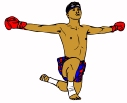
As we here at the IKF have always done for our fans of these pages, we always try to educate "EVERYONE" on aspects of our sport and maybe a short class here in Muay Thai 101 will help to form where this article is going. Some of you may know most if not all we will teach in this class while others will answer honestly, "Oh, I didn't know that." So let the class begin… Nearly every weekend around the world there's a kickboxing event that advertises they will feature the long honored fighting art of Thailand known as Muay Thai. If these fighters are both following true MuayThai tradition, they will both enter the ring over the top rope. Why? In MuayThai tradition, the Mongkon (headpiece wore around the top of each fighters head prior to their bout) is blessed for good luck by each fighters respected religion. Going over the top rope is symbolic that God is Above All Things such as the ring ropes. The spectators and their peers see 2 fighters dressed in the traditional Muay Thai shorts with their Mongkon wore proudly on their head. Once in the ring the traditional MuayThai music begins and a fighter has their first options of the bout. However in Thailand, this is NOT an option and SHOULD NOT be an option even in other parts of the world. These options are not fighting options such as "Should I throw a Jab or a knee etc." these options are the ones of long and honored traditions of Muay Thai. To seal the ring (The walk around the ring which symbolizes the sealing of evil spirits from the ring), begin their Wai Kru (Wai means Bow and Kru means Teacher. When the fighter bows down paying homage to their teacher, club and family) and or a Ram Muay. (Which translates into boxer dance) or to simply stand and await for their opponent to be ready and the referee to begin the bout. Keep in mind that not all MuayThai fighters perform these things. Even in Thailand, they are a fighters choice. If a fighter decides to seal the ring we'll see them stopping to pray in each corner. In Thailand, the Wai Khre is paying homage to their Buddha. This pray continues at each corner during their walk to all four corners. Once again, a fighter may now choose to perform a Wai Khre followed by their own version of their Ram Muay. Often during a fighters Ram Muay, many true fans of Muay Thai fighting may not know what the dance is for. To answer this question, the dance expresses a fighters balance and agility. Sometimes at it's end, it may be followed by a show of confidence or challenge towards their opponents corner such as a stomping of their feet or an imitation of shooting an arrow at their opponent. To true fans of the sport, this is all part of the bout as well. As each fighters rituals ends, the trainer removes their Mongkon and turns to face their opponent.
|
|
|
THE HISTORY OF IKF MUAY
THAI | ||
|
HOME - NEWS - EVENTS - RANKINGS - SANCTIONING - JOINING - RULES & REGULATIONS - MERCHANDISE - ISCF MMA - IAB BOXING | ||